

A secure data engineering platform for Snowflake teams
Datacoves is an end-to-end data engineering environment that runs inside your cloud and integrates with Snowflake, giving teams consistent development, orchestration, and governance without changing how Snowflake works.
Explore DatacovesSnowflake provides a powerful, flexible data cloud
Teams still need a consistent engineering environment around it.
How Datacoves supports Snowflake teams
Datacoves helps teams develop, govern, and deliver analytics with confidence.

Secure by default
- Datacoves runs inside your cloud
- Snowflake credentials stay in your control
- No SaaS data plane, no VPC peering required

Consistent engineering workflows
- Standardized dbt + Python environments
- Managed Airflow aligned to Snowflake workloads
- Git-based development and CI/CD

Proven patterns, not rigid platforms
- Reference architectures for Snowflake + dbt
- Opinionated defaults with flexibility
- Support for how your team works
A reference data architecture built around Snowflake
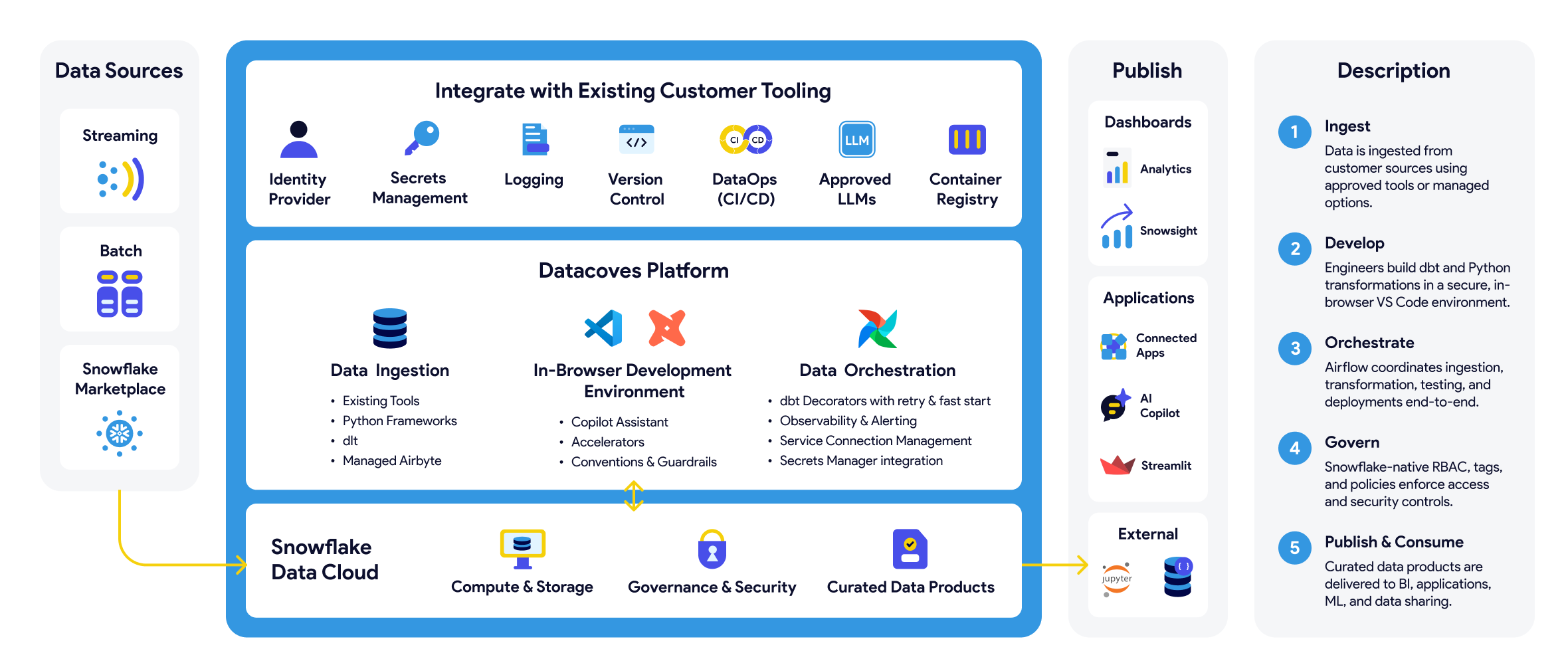
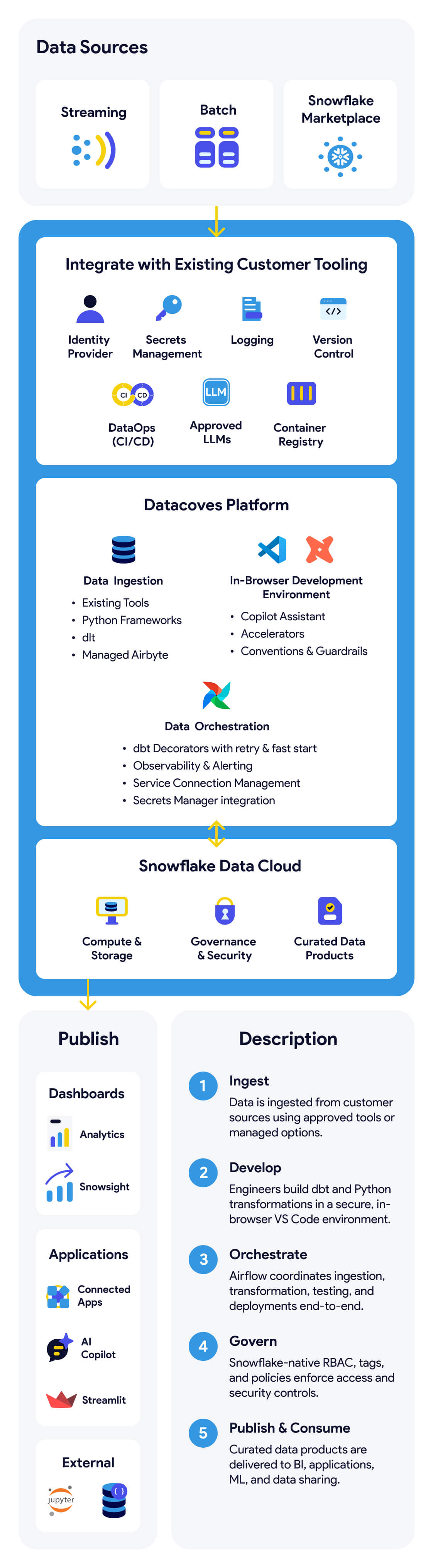
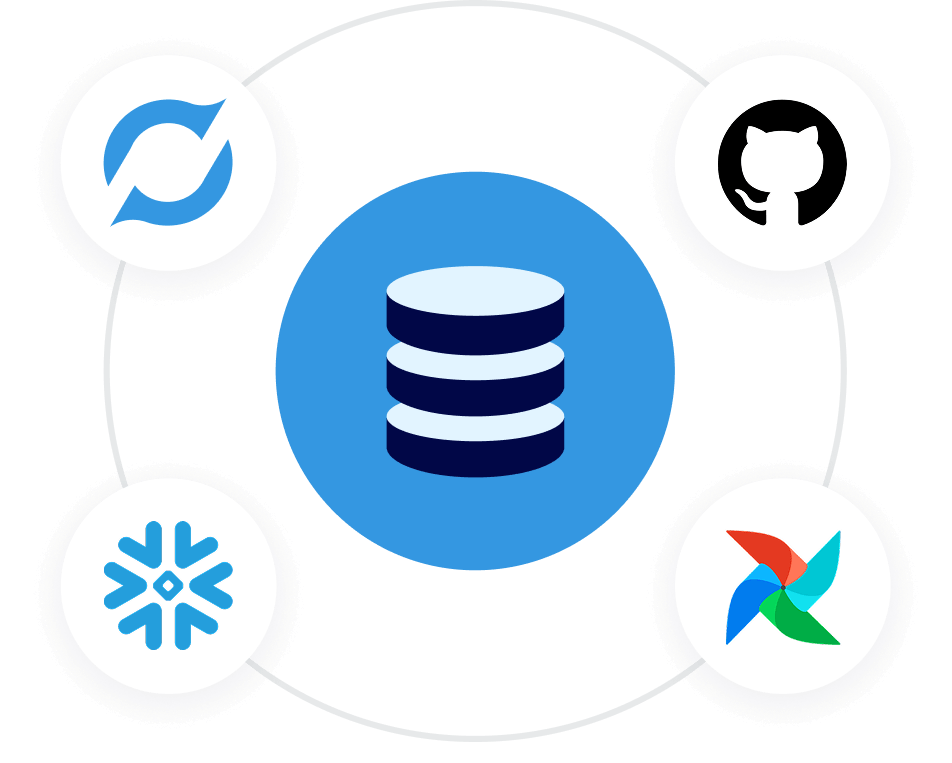
Sources ingested via your tool of choice

Orchestrated with Managed Airflow
Transformed with dbt
Developed in standardized VS Code environments

Deployed with CI/CD guardrails
Observed with lineage, logs, and metadata

All running inside your cloud
We don't just give you a platform and wish you luck.
Datacoves comes with a proven implementation framework: database organization, data layers, naming conventions, Git branching strategies, CI/CD pipelines, Snowflake security-as-code, and Airflow best practices.
All pre-configured. All customizable. It's what a world-class engineering team would build if they had 6 months. We deliver it in weeks. Teams at J&J, Guitar Center, and Kenvue used this framework to go from setup to production data products in a fraction of the time a DIY approach would have taken.
Datacoves vs. common Snowflake setups
See how Datacoves simplifies and strengthens common setups.
Frequently asked questions
Find answers to your questions below. Contact us if you couldn't find what you're looking for.
Contact UsHow does Datacoves work with Snowflake?
Datacoves runs Managed dbt and Managed Airflow against Snowflake from your own cloud, with VS Code in the browser, pre-built CI/CD and secrets management. Datacoves is a Snowflake Technology Partner. Snowcap, our open-source tool for Snowflake infrastructure and RBAC as code, is available alongside it.
Which data warehouses does Datacoves support?
Snowflake, Databricks, BigQuery, Redshift and others. Datacoves works with any warehouse that has a dbt adapter, open source or proprietary.
Can you use Snowflake Cortex CLI inside Datacoves?
Yes. Snowflake Cortex CLI runs in the Datacoves VS Code environment alongside other AI coding tools, so developers can use it without leaving the platform or installing it locally. Datacoves lets you choose which LLM backs the AI tooling you use.
Does Datacoves support Private Link?
Yes, Datacoves enables secure deployment within your network with PrivateLink connections to your warehouse.
Do you still need an orchestrator if you use dbt?
dbt has no scheduler of its own, so something has to decide when it runs. For local development or a single nightly build, cron or a hosted dbt scheduler is enough. You need a real orchestrator once the pipeline spans more than transformation: ingestion ahead of it, BI refreshes or activation behind it, dependencies across systems, and retries that resume at the failure rather than restarting everything. Airflow is the most widely adopted choice, with Prefect, Dagster and GitHub Actions as alternatives. The dbt Platform’s own scheduler covers dbt runs but doesn’t coordinate the rest.
How do I manage Snowflake roles, users, and grants alongside dbt?
dbt manages objects inside the warehouse (tables, views, tests). It does not manage Snowflake itself. Use a Snowflake-native infrastructure-as-code tool like Snowcap to version-control roles, users, grants, warehouses, and policies.
Is Datacoves optimized for Snowflake?
Yes, while all dbt adapters are supported, Datacoves is built to shine with Snowflake, with ready-to-use security scripts, tailored macros, and streamlined setup.
What does a Snowflake implementation include?
A Snowflake implementation typically covers deploying the warehouse, migrating existing data, and setting up basic access controls. What it usually doesn’t include is the engineering environment your team needs to develop consistently, orchestration to run and monitor pipelines, CI/CD to enforce quality, or the conventions that make the platform maintainable over time. Those require deliberate work that sits outside most warehouse contracts.
What is Snowcap?
Snowcap is an open-source tool from Datacoves for managing Snowflake infrastructure and RBAC as code. You define roles, grants and objects in YAML, review changes in Git, and deploy them with a plan and apply step. See snowcap.datacoves.com.
What makes Datacoves a better choice than running dbt natively on Snowflake or Databricks?
Native dbt integrations on Snowflake or Databricks provide transformation capabilities but not orchestration, governance, or a development environment. Datacoves adds Managed Airflow for scheduling and dependency management, VS Code in the browser for development, CI/CD pipelines for testing, and a data catalog for governance, all without requiring your team to set any of this up themselves. Organizations also find the dbt within data platform providers is typically limited and not as full featured.
What questions should I ask a Snowflake implementation partner before signing?
Before signing with any SI or platform vendor, ask: Can you show me a client whose team ships independently without your firm in the critical path? What open-source tools does your approach use and how are upgrades handled? Who on our team will own the models and deployment process after you roll off? How is data quality enforced, and where in the pipeline does it happen? The answers will tell you whether they’re building you a platform your team can operate or a system only they can maintain. For a full breakdown, see our data migration partner guide.
Why is my Snowflake bill higher than expected?
Snowflake costs scale with compute usage. Without well-structured data models, query optimization standards, and sensible clustering strategies, credits burn fast. A single unoptimized full table scan on a large table can consume more credits in one run than a well-structured incremental model consumes in a week. Teams that skip the engineering foundation often spend their first year optimizing for cost rather than delivering new capabilities. The savings from migrating off the legacy system quietly get absorbed by an inefficient setup.
Why do enterprises trust Datacoves for managing data?
“Datacoves enabled us to reduce time to market by delivering a secure pre-configured environment for dozens of Analytics Engineers and to implement best-in-class DataOps processes on a dbt and Snowflake foundation”

“Without Datacoves I would have needed a whole team to get all of these services put together and integrated”

“Datacoves solves the infrastructure problem. Datacoves packages together all the tools needed to support data teams of all sizes.”

“The stability, Kubernetes-backed scalability, and overall reliability of the Airflow environment have been the cornerstone of achieving our data system goals.”

“We have a background in Data Architecture, but building a way of managing dbt and Airflow together would have been a project in itself.”

End-to-end data analytics with Managed dbt and Managed Airflow
Don’t let platform limitations or maintenance overhead hold you back.